How is wild animal use regulated? Are there measures that protect wildlife? Who is responsible for creating those safeguards?
The Convention on Biological Diversity (CBD), in collaboration with the Convention on International Trade in Endangered Species (CITES), the Convention on Migratory Species (CMS), and other partners, is developing the first-ever CBD-wide global guidance on sustainable wildlife management. If adopted, the non-legally binding guidance could shape how countries manage, trade and harvest wildlife.
From 27 July to 1 August 2026, governments and experts are meeting in Nairobi for the 28th meeting of the Subsidiary Body on Scientific, Technical and Technological Advice (SBSTTA-28) to the CBD. SBSTTA provides scientific, technical, and technological advice to support countries in implementing the Convention.
Under Agenda Item 6, SBSTTA-28 is reviewing the draft global guidance and will prepare a recommendation for the next Conference of the Parties (COP) to the CBD. It is the top decision-making moment where government representatives are expected to formally adopt it. This CBD COP17 takes place in Armenia in October 2026.
But are the guidelines enough to protect wild animals, humans, and the ecosystems they live in? We are following these negotiations closely to ensure the guidance integrates the animal welfare perspective and upholds the “sustainable” dimension of wildlife management.
Making sustainable wildlife management humane and safe
Sustainability in wildlife management is often defined narrowly. It focuses on quotas or healthy population numbers rather than the lived experience of wild animals during capture, handling, transport, confinement and killing. In our position paper, we recommend strengthening the guidance in four ways.
First, ecological limits, recovery and thresholds should be the foundation of sustainability. A population number alone does not show whether a species can truly recover and persist over time.
In the Atlantic cod collapse in 1992, managers relied solely on raw counts and missed critical warning signs like shrinking geographic range and lost genetic diversity. This led to a sudden ecosystem collapse. Minimum viable population (MVP) thresholds could provide a safer framework, permitting wildlife use only where populations can demonstrably recover.
Second, precaution should be a core decision-making principle, especially where there is uncertainty. Where the ecological, health, or welfare impacts of wildlife use are not well understood, that use should not proceed unless there is sufficient evidence that the risks can be properly managed and that species recovery won’t be compromised.
Third, system integrity, traceability, and animal welfare safeguards need strengthening. Compliance with existing international regulatory frameworks, while necessary, should not be a sufficient demonstration of sustainability in wildlife use. Inconsistent traceability of wild animals that move through international supply chains can undermine conservation and welfare safeguards. For instance, weak tracking between wild-caught and captive-bred animals can let wild-caught animals be sold as captive-bred ones.
Fourth, understanding coexistence between people and wildlife as a practical pathway to real sustainability. This means, for instance, prioritising non-lethal, community-led approaches to conflicts between humans and wildlife. This can reduce harm for animals while also supporting the wellbeing of the communities who live alongside them.
Connecting wildlife management to One Health and biodiversity
SBSTTA-28 is also an opportunity to strengthen the practical links among animal welfare, biodiversity protection, and the One Health approach -which recognises the links between ecosystem, animal, and human health- in wildlife management.
Sustainable wildlife management grounded in real recovery thresholds and not just legal quotas can help implement several targets under the Kunming-Montreal Global Biodiversity Framework. This is CBD’s ambitious pathway to reach the global vision of a ‘world living in harmony with nature’ by 2050.
On the other hand, poor welfare can increase risks of pathogen emergence and zoonotic spillover. Weak traceability, overcrowding, and poor handling conditions increase this risk, since animals that are stressed, injured or poorly handled are more likely to spread disease.
Additionally, when animals die or are lost in the process, more may be taken from the wild to replace them, which amplifies pressure on already vulnerable species.
Protecting individual animal health and welfare therefore also protects entire species and ecosystems from disease outbreaks and repeated, wasteful extraction from the wild. If prevention, monitoring, and welfare safeguards are included at every stage of wildlife management (capture, transport, confinement, trade, and killing), these risks are automatically reduced.
WFA at SBSTTA-28
Wildlife is still declining at alarming rates, underscoring the need for sustainability to evolve into a holistic framework for managing wild animals.
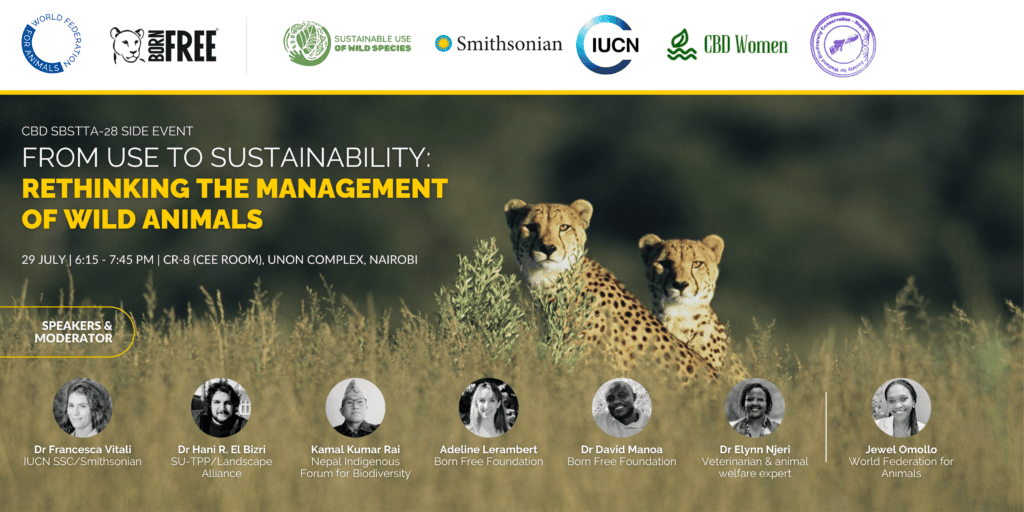
In that context, on July 29, WFA is co-hosting an official side event with the Born Free Foundation, “From use to sustainability: rethinking the management of wild animals.” Together with experts from the Sustainable Use of Wildlife Species Transformative Partnership Platform (SU-TPP), the International Union for Conservation of Nature Species Survival Commission (IUCN-SSC) and the Smithsonian Institution, the Nepal Indigenous Forum for Biodiversity and Society for Wetland Biodiversity Conservation Nepal, and the CBD Women’s Caucus.
The session aims to support governments and other stakeholders in advancing a more credible and truly sustainable approach to wildlife management.
Follow us on X, Facebook, Bluesky, or LinkedIn, and subscribe to our Weekly Digest to stay informed on news that matters for animals.