As the international community gathered in New York for the ten-year milestone of the United Nations High-Level Political Forum (HLPF), the urgency to accelerate progress on the 2030 Agenda resonated across all discussions.
With Sustainable Development Goals 3 (SDG3 Good Health and Well-being) and 14 (SDG14 Life Below Water) under review, the World Federation for Animals (WFA) made a compelling case for the vital inclusion of animal welfare in achieving sustainable development.
Through high-level advocacy and the hosting of a side event focused on One Health and advancing SDG 3, WFA reaffirmed its core message: if we want to truly leave no one behind, we can’t leave animals behind either.
One Health returns to the Ministerial Declaration
While the 2025 Ministerial Declaration showed progress on several sustainable development priorities, the Declaration was adopted by vote, rather than consensus, due to broader geopolitical disagreements.
Still, there was a meaningful win: The Declaration calls upon donors to recognise the value of a One Health to achieve health for all under SDG 3.
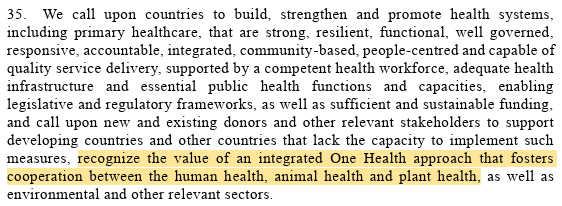
Although One Health was included in several pandemic-era HLPF Ministerial Declarations, it had been left out in recent years as the concept’s definition and inclusion were debated among countries. Its reinclusion in 2025, alongside the recent adoption of the Pandemic Agreement and the AMR FAO resolution, signals a growing global recognition of One Health and increasing awareness of the role animal welfare plays in sustainable development.
Advancing SDG 3 through One Health and animal welfare
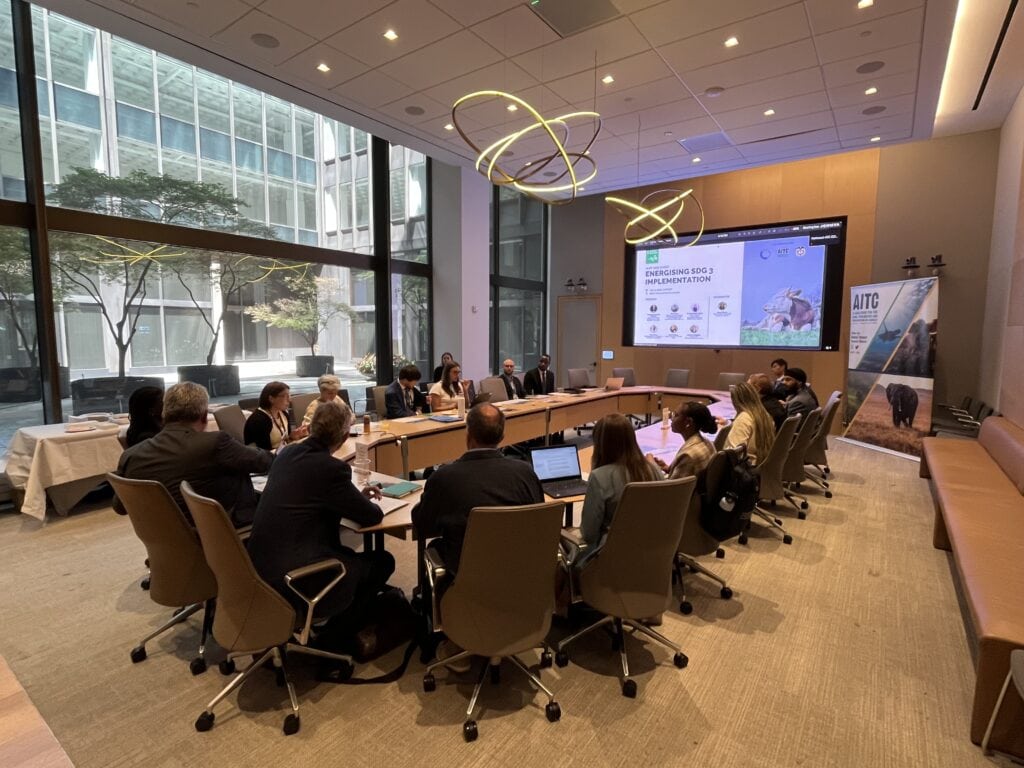
On 21 July, WFA co-hosted the official side event “Energising SDG 3 Implementation: A One Health Approach for Sustainable Well-being” alongside the Governments of Colombia and Thailand, and the Animal Issues Thematic Cluster.
The high-level panel brought together policymakers, UN representatives, scientists, and civil society leaders. Together, they explored how global health frameworks can be used to mainstream prevention through a One Health approach.
At the event, speakers agreed that collaboration is key across sectors, countries, and even with animals themselves. Colombia’s Ambassador Raúl Sánchez Niño opened the event by stating that “animals are vital partners in global health” and that “One Health is a bridge between science and solidarity.”
Will Hines, Director of Development and Open Societies at the UK’s Foreign, Commonwealth and Development Office, echoed this. He emphasised that antimicrobial resistance is a multisectoral challenge, one that demands joint solutions across human, animal and plant health systems.
From my side, I reflected on the cross-country collaboration that led to the Biodiversity and Health Global Action Plan. This is a milestone, since 196 countries have now acknowledged the link between biodiversity and health. They have also agreed that specific action needs to be taken to advance and improve this linkage.
Speakers also drew attention to the progress being made in localising integrated health frameworks. Chris Walzer, Executive Director of Health at the Wildlife Conservation Society, noted that African leadership (including the Africa CDC and governments like Zambia) is paving the way.
Dr. Saowapak Hinjoy, Director of International Cooperation at Thailand’s Ministry of Public Health, shared her country’s national One Health initiatives and how Thailand is championing the approach within ASEAN. She also reminded participants that “no country can protect itself alone”, reinforcing the need for regional and global cooperation.
Sira Secka, the lead negotiator for agriculture under the UNFCCC for the Gambia, highlighted the experience of integrated health frameworks in her own country. She pointed to the opportunity for countries in the Global South to avoid the problems currently being experienced in the Global North. “Are we going to prevent problems or are we inviting challenges that will later require solutions?” she asked the audience.
All in all, the event underscored that advancing SDG 3 requires action, solidarity, and shared responsibility. With strong momentum across regions, we now face an opportunity to deliver real progress for the health and wellbeing of humans, animals, and the environment.
Positioning animal welfare as a cornerstone of sustainability agenda
WFA’s engagement at the 2025 High-Level Political Forum reinforced a rising global consensus: sustainable development cannot be achieved without fully integrating animal welfare into the international agenda. From livestock on land to species in our oceans, the treatment of animals profoundly impacts human health, ecosystem resilience, and the equity of global food systems, making animal welfare not a side issue, but a central pillar of sustainable progress.