From 14 to 23 July, the UN High-Level Political Forum (HLPF) on Sustainable Development will review global progress towards two Sustainable Development Goals (SDGs) essential for animal welfare: SDG 3 (Good Health and Well-being) and SDG 14 (Life Below Water).
This HLPF offers a key opportunity to demonstrate that animal welfare is key to sustainable development.
The Ministerial Declaration and the One Health approach
For several months, UN Member States have been negotiating a Ministerial Declaration expected to be adopted by the HLPF.
The latest available draft of the Declaration emphasises the need to accelerate the implementation of the 2030 Agenda with science- and evidence-based solutions. It reaffirms global commitment to SDG 3 and SDG 14, underscoring the link between human and environmental well-being.
Although non-legally binding, this Declaration is important because it reflects consensus among governments on priorities for achieving the SDGs.
Earlier in the process, the UN released a paper outlining the structure of the Declaration. We welcomed its inclusion of the One Health approach, which recognises the interdependence of human, animal and environmental health.
However, the reference to One Health was not included in the zero draft of the Declaration. This is a missed opportunity. Animal health and welfare are central to preventing disease, reducing antimicrobial resistance (AMR), and supporting sustainable aquaculture.
The final Ministerial Declaration should reflect existing UN commitments and acknowledge that One Health “delivers multiple benefits to the health and wellbeing of people, animals, plants and ecosystems,” in line with previous UN resolutions and Ministerial Declarations.
Ocean health and aquatic animals
WFA has also expressed concern over the limited recognition of aquatic animal welfare in the Declaration’s draft. Poor welfare practices —such as overcrowding and excessive antibiotic misuse—can harm both animals and the marine environment. These issues threaten ocean sustainability and must be addressed.
In this context, we have urged UN Member States to draw from the Biodiversity and Health Global Plan of Action, adopted at the Convention on Biological Diversity (CBD) COP16 in 2024. This Plan encourages governments to improve animal welfare standards to reduce the risk of communicable disease in farm animals and aquaculture. Ocean health cannot be achieved without tackling these challenges.
Putting animals in the Sustainable Development Agenda
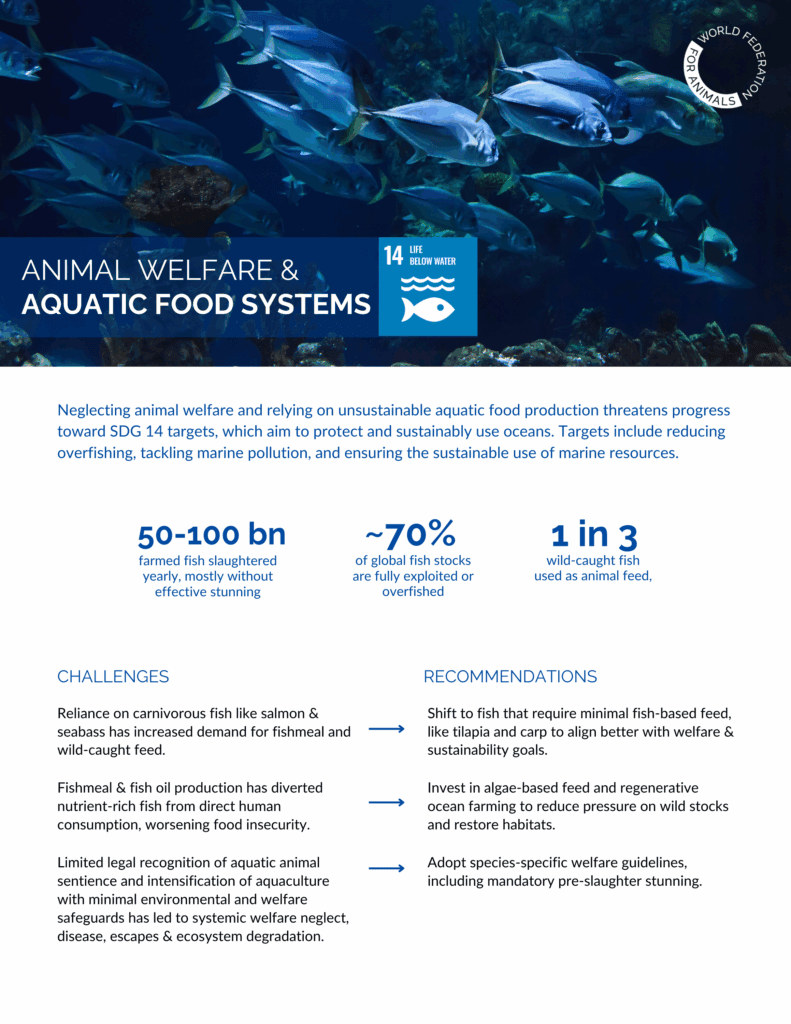
Throughout the HLPF, we will be displaying the evidence on why animal welfare is indispensable for SDGs 3 and 14. To support national and stakeholder engagement, we will be sharing short policy briefs on animal welfare and SDG 3, particularly on AMR, communicable and non-communicable diseases, as well as on animal welfare and SDG 14, on biodiversity conservation and aquatic food systems (see below).
Attend our official side event: “Energising SDG 3 Implementation”
Also, on 21 July, WFA will co-host an official side event with the Government of Colombia and the Animal Issues Thematic Cluster. The event “Energising SDG 3 Implementation” will explore how global frameworks—such as the Pandemic Agreement and the AMR Political Declaration—can support more integrated and preventative approaches to public health.
Register here to attend our side eventTime to act: urgent call to governments
With only five years remaining to achieve the 2030 Agenda, countries must make bold choices. Recognising animal welfare is not optional. It is a prerequisite for sustainable health systems, resilient ecosystems and equitable development.
WFA calls on all governments to:
- Support strong language on animal welfare and One Health in the Ministerial Declaration
- Invest in animal health and welfare as part of national SDG strategies
- Align ocean and aquaculture policy with welfare standards to meet SDG 14
“The HLPF is a crucial platform to remind world leaders that animals matter and to ensure they are part of the global sustainability agenda. Their wellbeing is deeply connected to human and planetary health. If we want to truly leave no one behind, we can’t leave animals behind either
Jessica Bridgers, Deputy CEO at World Federation for Animals
Photo credits: Lukas Vincour / We Animals