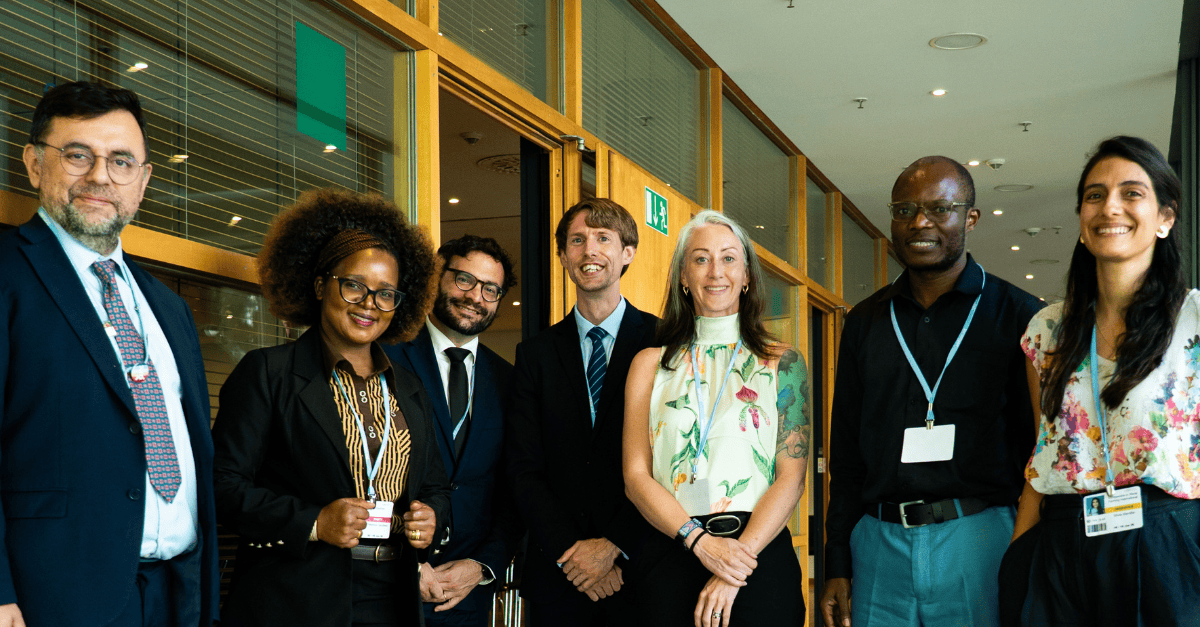
Scientific cohort behind the ‘Scientific Consensus on Wildlife & Climate’ co-author article in Wiley’s environmental change journal
The launch of the Scientific Consensus on Wildlife and Climate in June has been given further weight with a peer-reviewed article published in ‘Global Change Biology’, the leading environmental change journal from Wiley. The consensus, which has been endorsed by over 350 global scientists to date, acknowledges the positive role that wild animals can play in climate change mitigation, and calls on governments to explicitly incorporate wildlife and their ecological roles into climate policies and frameworks.
Across the world, every day, trillions of wild animals naturally support ecosystem functioning through their natural behaviours. The Scientific Consensus on Wildlife and Climate website showcases a handful of examples to bring this science to life. From dugongs recycling nutrients and dispersing seeds in seagrass meadows to Asian tigers controlling herbivore prey and having cascading effects on how much carbon is stored in forest vegetation.”
The manuscript, “Wildlife and Climate” scientific consensus on the roles of wild animals in the global carbon cycle and natural climate solutions” has been co-authored by 13 scientists who collectively drafted the wording in the consensus. Published on 25 September 2026, in the journal’s ‘Science behind the news’ section, it explores the ways that wild animals drive ecosystem processes that can regulate carbon storage and greenhouse gas flux. It also appeals to policymakers to bridge the gap between scientific understanding and climate policy in order to unlock the full potential of wildlife to support climate mitigation, resilience, and adaptation.
Momentum is gathering ahead of COP31 in November, as a global, African-led, voluntary Wildlife for Climate Declaration is due to be launched. This is an exciting opportunity for countries to recognise wildlife as part of the functional basis of climate-resilient ecosystems, to strengthen knowledge-sharing and consider animal-mediated processes in existing policies where nationally appropriate, as called for in the Consensus.
Nathan Roberts, of Northeast Forestry University, Harbin, China, who coordinated the article, comments, “The endorsement of the Scientific Consensus on Wildlife and Climate by over 350 global scientists marked a huge step in the collective recognition of the role of wild animals in ecosystem functioning and the need to better incorporate wildlife in nature-based climate solutions. Securing this peer-reviewed article in Global Change Biology now raises further international awareness in the science and policy space of the importance of wildlife in more holistic and effective climate action. With COP31 just a few months away, it is encouraging to see the acceptance, openness, and new conversations being had in this area, and as we continue to advance the science, we look forward to seeing how countries carry this forward in their climate actions, plans, and dialogues.”
Ed Goodall, Climate Policy Specialist, World Federation for Animals adds ”Wildlife have been viewed for too long as passive participants in the Earth system and victims of a changing climate. However, science is showing us that it is the complex web of interactions, driven in large part by animals, that has provided us with the habitable home we share today. Losing animals and the roles they play is not unrelated to the dysregulation of our planet, and by removing threats and returning land and ocean to them will increase resilience and help drive more carbon into ecosystems.”
Matt Collis, Senior Director of Policy at the International Fund for Animal Welfare (IFAW) said: “Climate policy has largely overlooked a powerful ally in tackling climate change—wild animals. This growing body of science shows that protecting wildlife isn’t only about preventing species loss, it’s also about keeping the ecosystems we depend on healthy, resilient, and storing carbon. With COP31 approaching, governments have an opportunity to turn that science into action. Wildlife and the ecological roles animals play should be recognised in climate strategies, from national climate plans to investments in nature-based solutions. Protecting and restoring wildlife populations can deliver benefits for animals, people, biodiversity, and our climate, and that makes it an opportunity we cannot afford to ignore.”
-Ends-
For further information or interview requests, please contact: Victoria Evans: victoria.evans@wfa.org / +44 (0) 7766 244 322
Notes to Editors
- The World Federation for Animals is a not-for-profit global federation comprising over 70 animal welfare organisations. Established in 2020, it works to embed animal welfare into sustainable development worldwide. A UN-accredited organisation, it works towards the recognition and integration of animal welfare into international health, food, and environmental regimes and trade and development finance rules.
- Global Change Biology is a leading international journal published by Wiley, dedicated to advancing understanding of the biological dimensions of global environmental change. Research published in Global Change Biology has been widely cited in major international assessments, including those of the IPCC, and has contributed to the scientific evidence base informing global climate policy discussions, including the Paris Agreement negotiations at COP21.The journal’s mission is to position biology at the forefront of global change research and to provide a platform for high-impact, interdisciplinary studies addressing the causes and consequences of environmental change across ecosystems.
- The article can be accessed here
- The article authors are:
- Nathan James Roberts, Northeast Forestry University, Harbin, China
- Trisha Atwood, Utah State University, Logan, Utah, USA
- Carolina Bello, ETH, Zürich, Switzerland & University of Rwanda, Kigali, Rwanda
- Fabio Berzaghi, Sasakawa Global Ocean Institute, World Maritime University, Malmö, Sweden
- Charles A. Emogor, University of Cambridge, UK; Pangolin Protection Network, Calabar, Nigeria & Harvard University, USA
- Ed Goodall, World Federation for Animals
- Ana Cristina Mendes-Oliveira, Federal University of Pará, Brazil
- Ninad Avinash Mungi, Aarhus University, Aarhus, Denmark
- Heidi Pearson, University of Alaska Southeast, Juneau, AK, USA
- Jérôme Pinti, Gulf of Maine Research Institute, Portland, Maine, USA
- Jayashree Ratnam, National Centre for Biological Sciences, Bangalore, India
- Oswald Schmitz, Yale University, New Haven, Connecticut, USA
- Jens-Christian Svenning, Aarhus University, Aarhus, Denmark