In June 2026, those engaged in the climate negotiations, including the World Federation for Animals (WFA), will head to Bonn, Germany. These are the mid-year talks of the subsidiary bodies of the UN Framework Convention on Climate Change (UNFCCC SB64).
These mid-year sessions may be seen as purely technical, but it is here that negotiators and civil society will shape the agenda of the 31st Conference of the Parties (COP31). With the UNFCCC workstream on food and agriculture set to conclude this year, and the Ocean & Climate Dialogue set to feed directly into COP31 decisions, Bonn is a critical moment to ensure animal welfare is integrated into global climate policy.
On the agenda are a few topics that governments will discuss, which can impact animals’ lives around the globe. Here’s what we at WFA have our eyes on: climate action on agriculture and food security; ocean-climate-based action; and cooperation between the climate, biodiversity, and desertification agendas.
1. Climate action on agriculture & food security
A couple of things worth noting on this agenda item.
First, parties to the UNFCCC and stakeholders will discuss the means of implementation for climate action in agriculture and food security at a three-part workshop. Means of implementation include capacity building, finance, and technology transfer. Scaling these up for sustainable food production and consumption can improve the lives of millions of farmed (and wild) animals.
Today, significant public finance supports high-emission, environmentally damaging practices, such as industrial animal agriculture. Climate negotiators must address how to redirect these subsidies towards higher-animal-welfare, lower-emission food production, while creating conditions that encourage plant-rich diets and protein diversification. Doing so can help countries accelerate progress towards their mitigation and adaptation targets while ensuring food security.
Second, negotiators in Germany will pick things right up where they left them in Brazil at COP30. In November last year, they reviewed progress under this UNFCCC workstream and agreed to continue considering a draft text on the topic. The draft text has some encouraging elements. It highlights the potential of agroecology, for example. It also notes that an approach to building sustainable food systems that encompasses all components of the value chain, from production to consumption, is essential for ensuring food security and can help reduce greenhouse gas emissions. This is important. Attention often falls on the production side, even though dietary shifts are also essential to sustainable climate action.
The UNFCCC workstream dedicated to food and agriculture is set to conclude by COP31 later this year, making Bonn one of the last opportunities to shape what the workstream ultimately delivers. With food systems driving around a third of global greenhouse gas emissions, what negotiators agree on here will influence the ambition of climate policy for years to come.
2. Ocean-based climate action
Over two days in the first week of the Bonn talks, Parties will discuss the barriers, enabling conditions, opportunities, and good practices for coastal resilience; conservation and restoration of blue carbon ecosystems; fisheries and aquaculture; ocean-based renewable energy; and decarbonisation of maritime transport and shipping. These are all policy areas that can greatly impact the welfare of aquatic animals.
An obvious one is aquaculture. Often promoted as a more sustainable alternative to wild-catch fishing, aquaculture can also carry significant biodiversity and climate risks, particularly when it relies on carnivorous species and poor animal welfare standards. Instead, carefully governed, low-impact aquatic food systems, such as seaweed farming, can support climate resilience and livelihoods while having lower environmental impacts.
Another example of how important the topics of this dialogue are for animals is shipping. It is not only a major and growing source of greenhouse gas emissions, but also of underwater noise and ship strikes, especially for whales and other large marine animals. Instead, there are operational measures, such as speed reductions, that can cut emissions, noise, and collision risk at the same time.
Across all five topics on the agenda, there are opportunities to advance climate action in ways that simultaneously benefit aquatic animals and the ecosystems they depend on. The Ocean & Climate Dialogue will produce an informal summary report, and the co-facilitators have made clear they intend its findings to feed directly into COP31 decisions later this year. But the stakes go beyond a single COP: the 2026 Dialogue is explicitly designed to generate concrete, actionable recommendations that feed into the five-year ambition cycle of the Paris Agreement’s Global Stocktake, making it a key moment to shape ocean-climate policy for years to come.
3. Cooperation between the climate, biodiversity, and desertification agendas
Article 7 of the Convention states that the UNFCCC Conference of the Parties shall seek and utilise the services and cooperation of competent international organisations and intergovernmental and non-governmental bodies. In this context, the UNFCCC secretariat has been preparing an annual information paper summarising relevant cooperative activities.
Earlier this year, governments and observers were invited to submit views on how to make UNFCCC cooperation with other organisations more inclusive and strengthen collaboration with the other Rio Convention secretariats. Negotiators at Bonn will review these submissions and take this further.
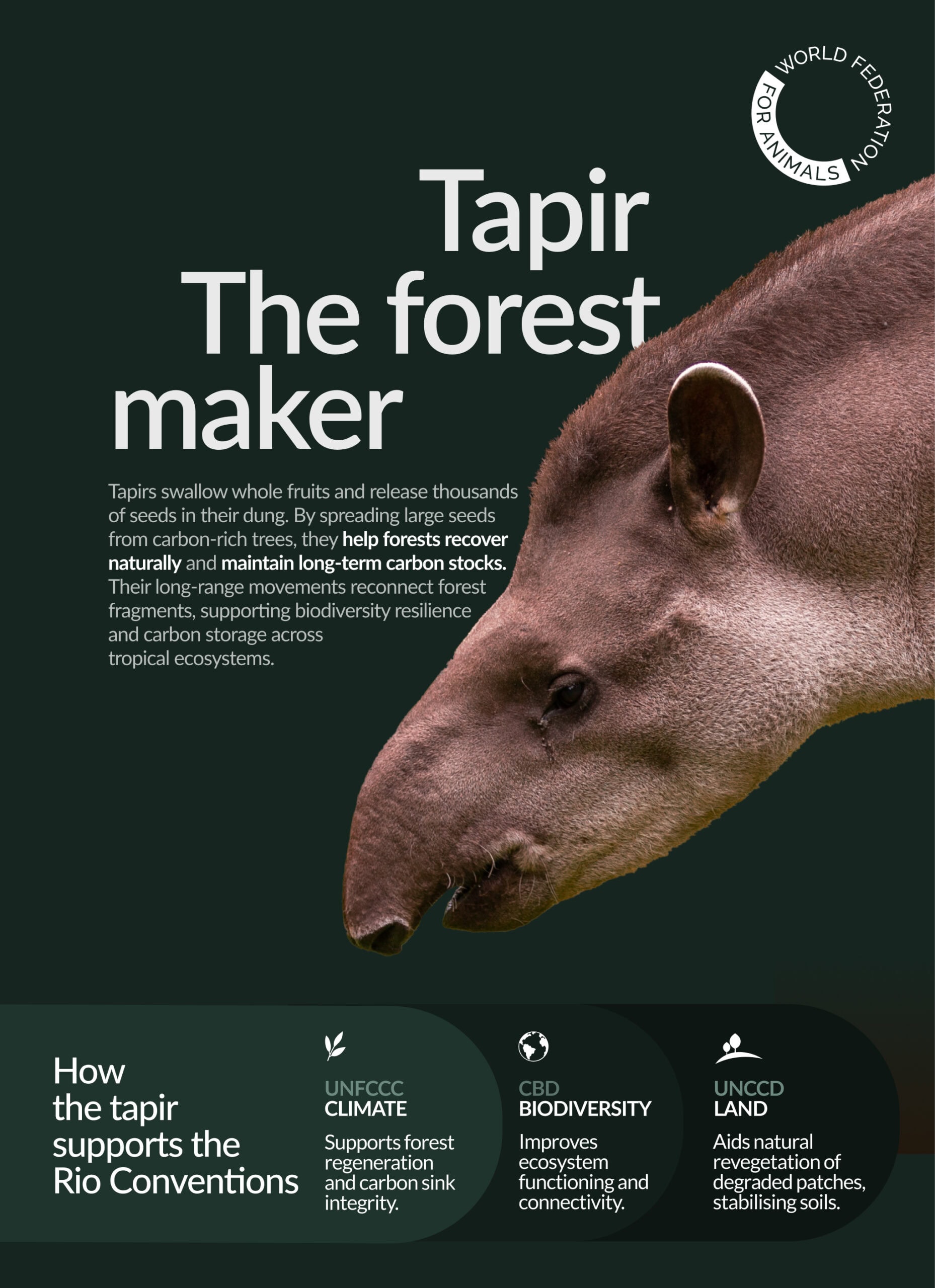
This may sound procedural. For animals, though, it creates an opportunity. While the three Rio conventions on biodiversity (CBD), climate (UNFCCC), and desertification (UNCCD) have distinct mandates, the international community has begun to acknowledge the need for effective ways to make consistent progress on these fronts. And animals and their welfare are a great example of how those synergies can be leveraged. In fact, transforming food systems and protecting wild animals are among the most powerful tools available for delivering on the Rio agenda as a whole. Take the tapir, as an example.
WFA in Bonn
On 11 June, the Wildlife and Climate Consensus, reached by nearly 250 leading scientists from around the world, will be unveiled, confirming that wildlife protection is a credible climate solution. Watch the press conference.
On 18 June, the final day of the Bonn talks, WFA will co-host a side event with the Government of Zimbabwe, IFAW, and Eurogroup for Animals: Wildlife Counts for Climate: The Scientific Consensus. A growing body of research shows that wild animals actively shape ecosystems in ways that are significant for climate mitigation, adaptation, and resilience, and a group of leading scientists from across the world has come together to synthesise this evidence into a global Scientific Consensus, which will be launched during the first week of SB64. Our event offers a deeper dive into the evidence and its policy relevance, with a Q&A between scientists and government representatives from Africa, Latin America, and Europe.
Follow us on X, Facebook, Bluesky, or LinkedIn, and subscribe to our Weekly Digest to stay informed on our presence at Bonn, plus on news that matters for animals.